Service
Renovations & Extensions
Working with what's already there — alterations, extensions, second-storey additions.
Why renovations are priced differently
Renovations don't go through the QS software Stoak uses the same way a new build does. The software works off measurable quantities — m² of cladding, lineal metres of joinery, framing patterns, services layouts — and a renovation always has an existing-conditions component that resists that kind of measurement. Pricing is benchmarked against comparable past renovations instead, which is honest but inherently less precise than a new-build estimate.
The other reason: the unknown factor. Once you open a wall, you can't always predict what's been done to the house over the years. Hidden borer, undersized framing, services that don't match the plans — those aren't anyone's fault, they're just what older houses surface when you start cutting in. Good documentation manages that, it doesn't eliminate it.
How the fee runs
- Concept fee — fixed, set per project type.
- Developed design fee — fixed where applicable. May be excluded for simpler scope; that's discussed and decided at proposal stage.
- Working drawings — a percentage of the estimated build cost. The percentage rate sits at the higher end of the calculator's bands — similar in scale to a multi-unit project.
The percentage is higher because the design and documentation work *relative to the build budget* is greater on a renovation. Build costs per square metre are typically *higher* than a new build (demolition, rework, working into existing structure all carry costs that a clean new-build doesn't), and overall budgets are typically smaller. That combination means the design effort relative to the budget is greater — the percentage reflects that.
What's included
3D renders are generally included. They may be excluded for very simple scope where they don't add anything to the build — that's discussed and decided at proposal stage. Renders and walkthroughs can be added on at any stage if the scope grows. Walkthroughs aren't standard for this service.
Real examples
- Old Taupo Reno — three separate rooms opened up to one. Removed walls, hanging beams, ridge beam expressed as a feature, new pool bathroom off the back.
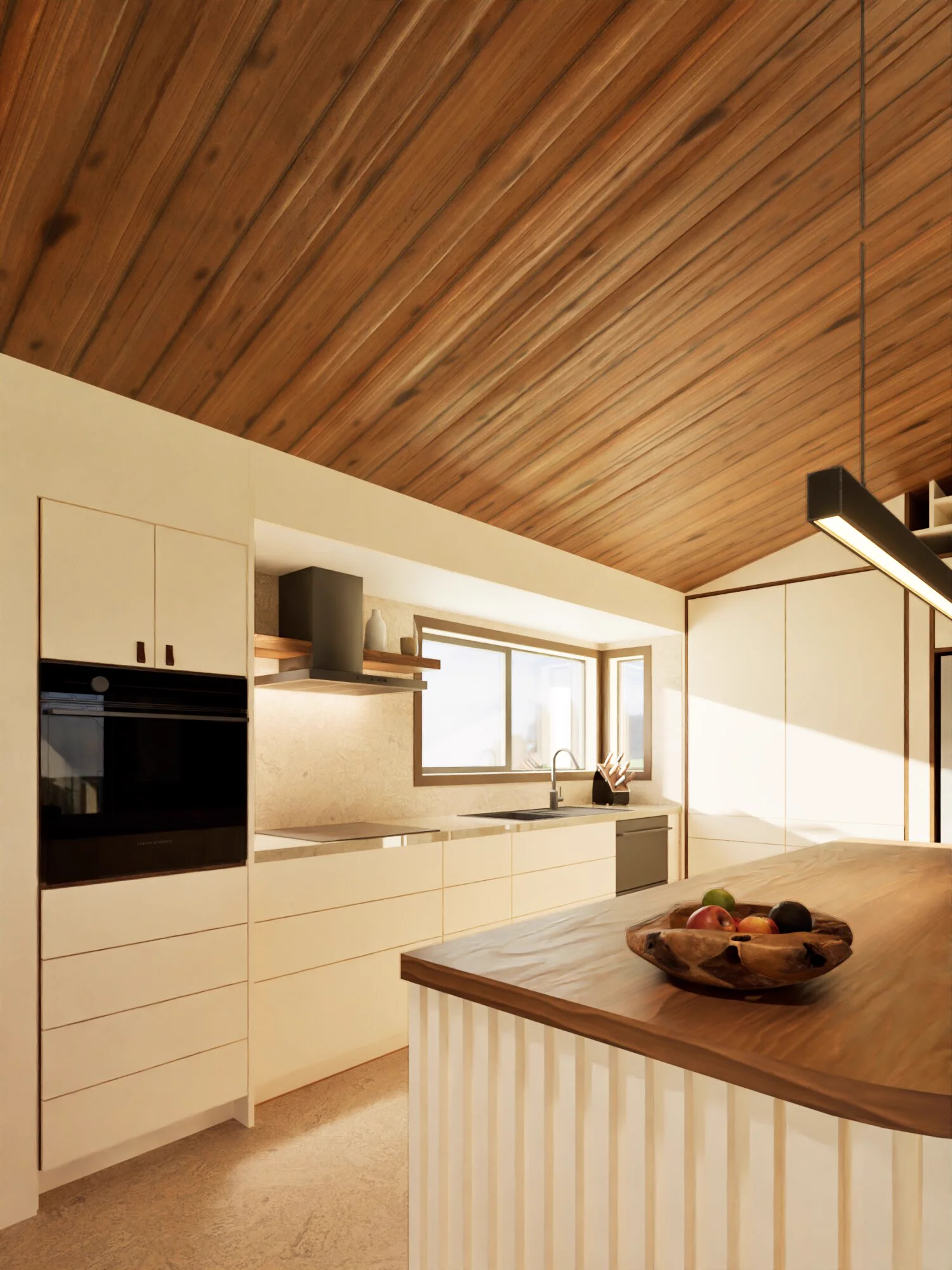
- Okareka Lockwood Reno — a Lockwood home re-roofed with insulated panels (Metalcraft Aspirespan), opened up internally, kitchen relocated and cantilevered.
- Hamurana Road House — re-clad of part of the road-facing facade, ensuite carved out of an existing space, new ground-floor extension with a full-width timber deck above.
How a renovation project runs
-
Site meeting + existing-conditions survey
Site walk-through and survey of the parts of the house being touched. Existing services, structure, finishes catalogued where relevant.
-
Proposal
Written proposal with scope, stage fees and indicative programme. Whether developed design is included is decided here. Engagement signed and concept fee invoiced.
-
Concept
Layout options for the alteration and design of any addition. Two rounds of revision built into the fee.
-
Client approval of concept
Final concept signed off in writing.
-
Concept benchmarked
Concept benchmarked against comparable past renovations for an indicative build cost. Less precise than QS-software-pricing on a new build but honest about what renovations can be priced to.
-
Developed design
Where applicable — junction resolution where new work meets existing structure, specification development, structural engineer coordination where load paths change. Two rounds of revision.
-
Developed design priced
Where developed design is included — refined estimate from comparable benchmarks before working drawings.
-
Client approval of developed design and budget
Final design and price signed off — ready for working drawings.
-
Consultant quotes
Engineer, surveyor and any other consultants quoted. Working-drawings fee confirmed in writing as a percentage of the estimated build cost.
-
Working drawings
Full consent documentation covering both the alterations and any new addition. Weathertightness strategy at new-to-existing junctions, structural detailing, services. Consent lodged and RFIs handled.
Frequently asked
- How is the fee priced?
- A fixed concept fee, a fixed developed-design fee where it applies, and a percentage of the estimated build cost for working drawings. The percentage sits at the higher end of the calculator's bands. Current figures are live on the sidebar.
- Why is the percentage higher than a new build?
- Renovation build costs per square metre are typically higher than a new build because of demolition and rework — but overall renovation budgets are usually smaller and the design and documentation work relative to that budget is greater. Working into an existing structure asks more design thinking than designing from scratch — every junction has an existing condition to resolve, every service has to dock into something already there. The percentage reflects the design work relative to the budget, not the build cost per square metre.
- Do I need a Building Consent for an internal alteration?
- Most internal alterations need a Building Consent — particularly anything that touches load-bearing walls, plumbing, drainage, fire ratings or accessibility. Cosmetic-only changes (paint, finishes, non-structural fixtures) are usually exempt under Schedule 1. If you're unsure, send a description through and I'll tell you which side it falls.
- Are 3D renders or walkthroughs included?
- Renders are generally included. They may be excluded for simple scope where they don't add anything — discussed at proposal stage. Renders and walkthroughs can be added on at any stage. Walkthroughs aren't standard for this service.
Ready to talk?