Service
Re-clads
Cladding remediation — full junction detailing, paper trail for council and your future buyer.
What's involved
Full design and consent documentation for a residential re-clad on any home where the cladding has failed or reached end-of-life. That covers leaky-era monolithic plaster, but it's not limited to it — failing brick veneers, end-of-life weatherboard, fibre cement that's let water in, anywhere the existing cladding has stopped doing its job.
The drawings cover every junction: head, jamb and sill flashings around windows; cladding-to-roof, cladding-to-soffit; control joints; expansion provision. The consent set is the paper trail your future buyer's lawyer will look for.
A note worth setting expectations on
Where cladding failure has allowed sustained water ingress, there's a real likelihood of rot in the framing behind it. How much depends on how long the leak has been there and where the water has tracked. On a small area it might be localised reframing the builder handles in passing; on a larger area it can push the project toward partial reframing scope, which a building surveyor is the right person to catalogue early.
This isn't a scare line — it's expectation-setting. Going in with eyes open keeps the project moving when something is found, rather than stopping the build to renegotiate.
Decisions at the start
- Like-for-like or upgrade? Most re-clads end up upgrading the cladding system at the same time — switching from plaster to weatherboard or shiplap, or to a profiled metal system. The wall is open exactly once.
- Insulation strategy. Now is when wall insulation, vapour barriers and air-sealing happen — fraction of the cost vs. doing it separately later.
- Windows. Many re-clads replace windows at the same time (often double-glazed or thermally broken aluminium).
How the fee runs
Leaner than a new-build engagement. There's a fixed concept fee to establish scope and decisions; there's no formal developed-design stage by default; before working drawings start, a build cost estimate is obtained (from a builder's pricing exercise on the concept or benchmarked against a comparable past re-clad). The working-drawings fee is a percentage of that estimate — same percentage band as renovations. Live numbers in the sidebar.
A real example
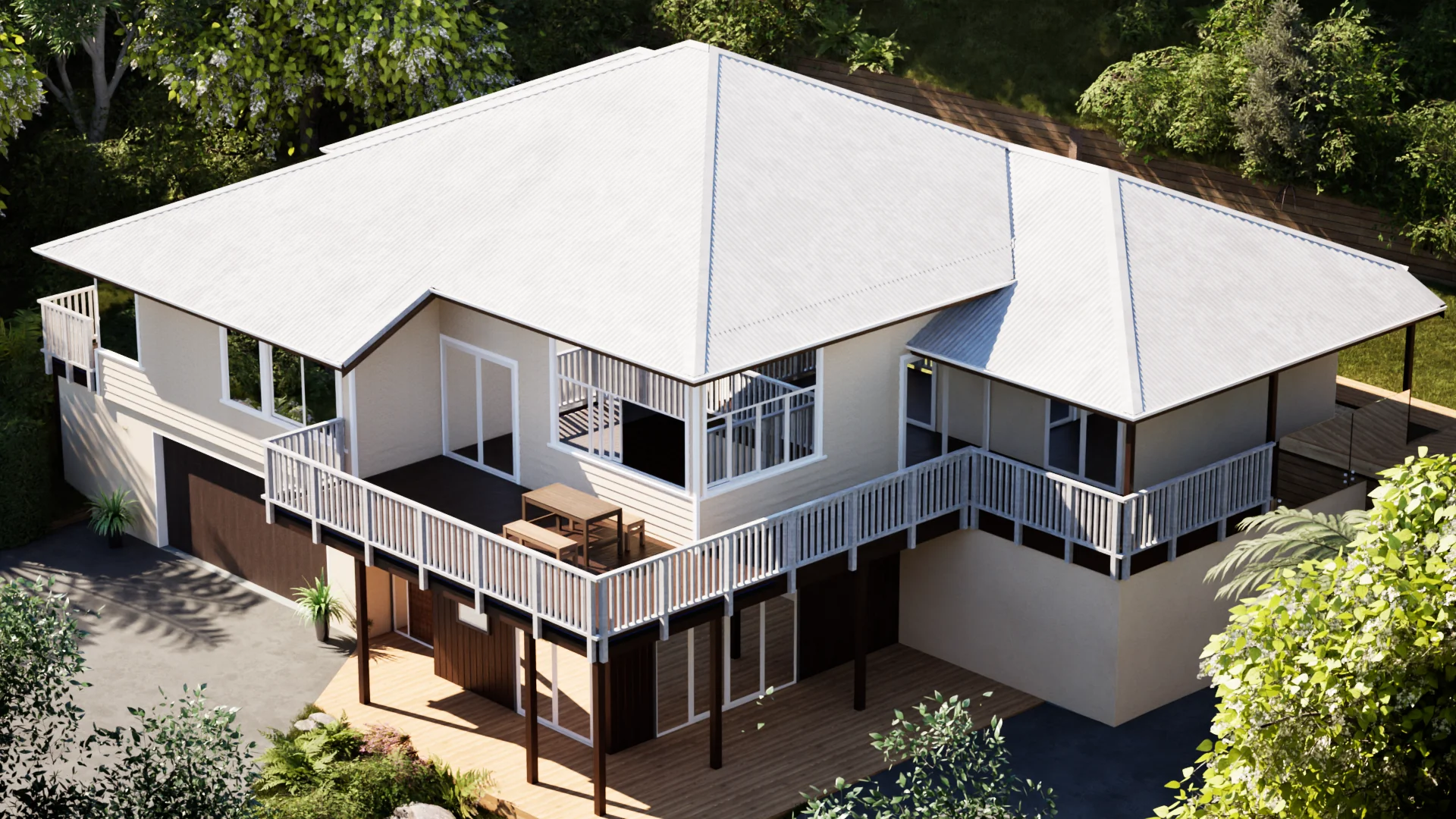
Hamurana Road House — a lakeside home where the road-facing facade had outgrown its appearance. The actual re-clad was on the upper floor only, replacing the existing brick. The ground floor was a new extension, with Abodo (Yoboto) vertical timber as its cladding. The Abodo was also carried over the existing block masonry on the ground floor as a rainscreen — not a re-clad on that section, but visual continuity that lifted the whole frontage to one read.
How a re-clad project runs
-
Site meeting + existing conditions
Site walk-through. Cladding condition assessed; visible warning signs (cracking, staining, soft skirting, damp smell) noted. Building surveyor brought in early where water ingress suggests reframing scope.
-
Proposal
Written proposal with scope, stage fees and indicative programme. Engagement signed and concept fee invoiced.
-
Concept
Cladding system, insulation strategy, window strategy decided. Scope agreed in writing. Two rounds of revision included.
-
Client approval of concept
Final concept signed off.
-
Build cost estimate
Build cost obtained — either from a builder's pricing exercise on the concept or benchmarked against comparable past re-clads. That estimate sets the working-drawings fee.
-
Working drawings
Full consent set: detailed junctions (head, jamb, sill flashings, soffit, head flashings to roof), drainage cavity specification, batten layout, fixing schedule, weathertight detail at every transition. Consent lodged and RFIs handled.
Frequently asked
- How is the re-clad design fee priced?
- A fixed concept fee to establish scope and decisions, then working drawings at a percentage of estimated build cost — same percentage band as renovations. There's no formal developed-design stage by default; the build cost estimate that sets the working-drawings fee comes from a builder's pricing exercise on the concept or benchmarking against comparable past jobs. Current figures are live on the sidebar.
- Will there be rot in the framing?
- Where cladding has let water in for any length of time, there's a real likelihood of localised rot. How much depends on the leak path and the duration. A building surveyor is the right person to catalogue this early — going in with eyes open keeps the project moving when something is found, rather than stopping the build to renegotiate. Stoak coordinates that scope where it's needed.
- Should I upgrade insulation while re-cladding?
- Almost always, yes. The cost of upgrading wall insulation when the cladding is already off is a fraction of doing it as a separate exercise later. Same applies to thermally broken or double-glazed windows.
- Are 3D renders or walkthroughs included?
- Renders are included for facade studies and material decisions. Walkthroughs are not part of this service.
Ready to talk?