Service
Multi-Unit Dwellings
Small to medium-scale multi-unit residential — duplexes, terraces, infill.
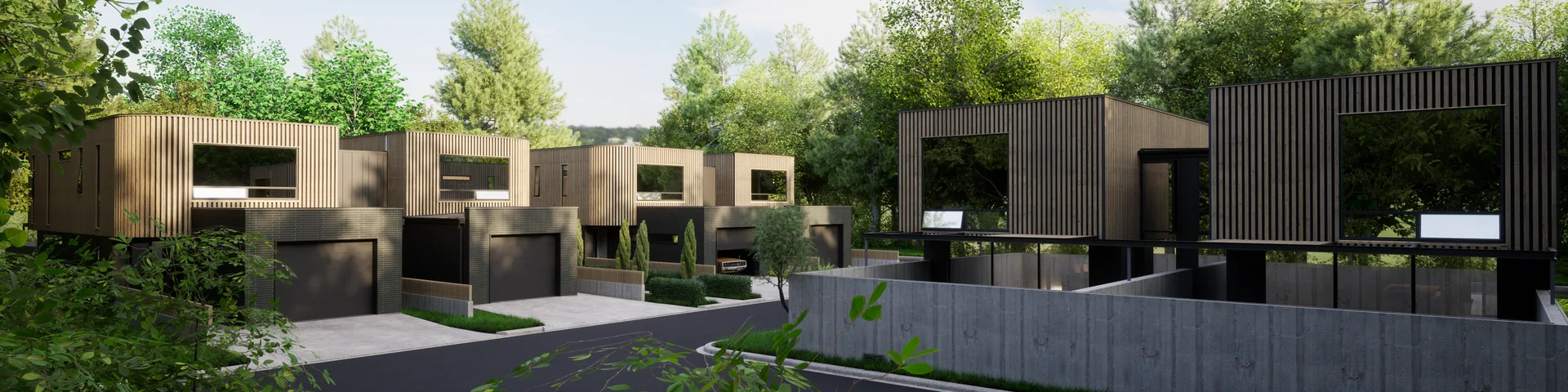
What we do
Small to medium-scale multi-unit residential design — duplexes, three-to-six-unit terraces, infill on existing residential sections, and bigger schemes where the brief and the site support them. The work covers both the individual dwellings and how they sit together within the wider subdivision layout.
Working alongside a residential planner
Multi-unit projects are rarely just about the buildings. The site geometry, the access, the parking, the orientation of each unit, the way the dwellings relate to each other and to the street — all of that is subdivision design, and Stoak works alongside a residential planner on those projects where the brief calls for it. Stoak handles the architectural side; the planner handles the lots, the engineering coordination at subdivision level, and the resource consent strategy for the site as a whole.
The technical bits
- Party walls — sound, fire and structural separation between units.
- Fire ratings — Building Code rules around firewalls, fire doors, fire-rated penetrations. Most simple multi-unit work fits the Acceptable Solution C/AS1 fire pathway; more complex projects need a fire engineer.
- Acoustic separation — particularly for stairwells and shared walls.
- Parking, manoeuvring and turning — District Plan rules vs. the available site, often the deciding constraint on a duplex or terrace.
- Stormwater — multi-unit sites often need on-site detention or rain gardens.
- Resource Consent — most multi-unit infill triggers Resource Consent because of density rules. The exact path depends on the council's District Plan.
How the fee runs
- Concept fee — fixed.
- Developed design fee — fixed.
- Working drawings — a percentage of the developed design build cost. The percentage sits at the higher end of the calculator's bands because design and documentation work per dollar of build is greater on multi-unit than on a single home. Multi-unit fees scale with unit count and site complexity. Live numbers in the sidebar.
A note on density rules
Density rules vary by council. Some New Zealand councils have adopted the Medium Density Residential Standards (which allow up to three dwellings per lot in many residential zones); others have not. The starting point for any multi-unit project is reading the live District Plan for the property — that's the cheapest first step.
How a multi-unit project runs
-
Site meeting + planning rules check
Site walk-through. Density and bulk rules pulled from the District Plan; whether subdivision is needed assessed. Planner brought in on subdivision-flavoured projects.
-
Proposal
Written proposal with scope, stage fees and indicative programme. Engagement signed and concept fee invoiced.
-
Site master plan + concept
Compliance check against the zone's density and bulk rules. Subdivision strategy worked through with a residential planner where the brief needs it. Unit-mix options, site arrangement and circulation, design of typical unit types. Two rounds of revision included.
-
Client approval of concept
Final concept signed off in writing.
-
Concept priced
Concept run through the QS software Stoak uses for an early build cost estimate.
-
Developed design
Resolution of unit types, party-wall and fire strategy, acoustic separation, services coordination. Two rounds of revision. Consultant team engaged — structural engineer, civil for stormwater and on-site detention where needed, fire engineer on more complex schemes.
-
Developed design priced
Developed design priced through the QS software.
-
Client approval of developed design and budget
Final design and price signed off — ready for working drawings.
-
Consultant quotes
Engineer, fire, civil and any other consultant quotes received. Working-drawings fee confirmed in writing as a percentage of the developed design build cost.
-
Working drawings
Full Building Consent set covering inter-tenancy fire and acoustic ratings, weathertightness across the development, services coordination across the site. Resource Consent runs in parallel where the scheme triggers it. Consents lodged and RFIs handled across both processes.
Frequently asked
- Can I subdivide my section and build a duplex?
- It depends on the section size, the underlying zone and the council's District Plan density rules. The cheapest way to find out is a feasibility study — a flat $500 + GST for a written report on what's possible.
- Do I need a fire-engineered design for a duplex?
- Standard duplexes can usually be built using the Acceptable Solution C/AS1 fire pathway — no separate fire engineering needed. Larger projects (3+ units, complex configurations, mixed use) often need a fire engineer.
- Do you only work on small-scale multi-unit projects?
- No — small to medium scale. The duplex / 3–6-unit terrace work is the most common, but the same approach scales up to bigger schemes when the brief and the site support them. Any project where the dwellings need to work together within a wider subdivision layout fits.
Ready to talk?